
Stripe vs PayPal: Which Payment Platform Should You Choose in 2026?
|
|


If you’re a small business, we will absolutely get it if you say you’re having a hard time choosing a payment platform for your company. And of course, finding the right platform alongside juggling customer service, tracking your finances, and running day-to-day operations can feel overwhelming and confusing.
Businesses who are in a similar dilemma like yours often have two top players to pick from, Stripe and PayPal. Both payment platforms are trusted worldwide, both help you accept payments quickly, and both have tools that make online transactions easier.
So, how exactly does one choose a winner in a Stripe vs. PayPal discussion?
Luckily for you, we have worked with both Stripe and PayPal, and although we don’t have a clear favorite, we do know the inside and out of both payment solutions.
Most Stripe vs. PayPal comparisons will tell you that both platforms have a lot in common. But we also know that Stripe and PayPal, despite their similarities, work in different ways and suit different business types.
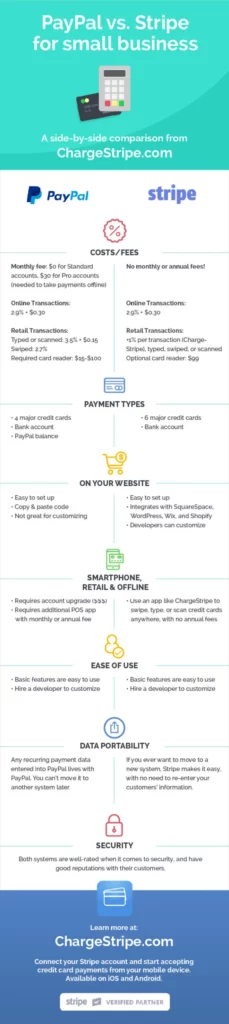
Source: chargestripe.com
This blog will give you a very clear and simple Stripe vs. PayPal breakdown so you can understand how each platform can cater to your needs. Whether you run a small online shop, sell services, run a subscription business, or manage a brick-and-mortar store, this guide will help you make the right choice.
At the end of the day, the decision will be yours. But with our overview of pricing, setup, ease of use, customer expense, and overall features, you will make that decision with confidence.
Ready to choose between Stripe vs. PayPal in 2026? Continue to read this blog.
But Why Does a Stripe vs. PayPal Debate Exist?
Stripe and PayPal have been around for many years, but their popularity continues to grow. The rise of online shopping, digital services, and remote businesses means seamless payment solutions are now more important than ever.
And this is exactly why Stripe vs. PayPal debate matters. Because as a small business owner who is about to invest time, money, and resources into adopting a technology; going wrong can cost you a lot. So, if you’re a business owner who doesn’t know the real difference between the two, this blog will help you understand which platform will work best for you in the long run.

Let’s Begin with Stripe
Stripe is widely known for being flexible and developer friendly. It works quietly in the background of websites and apps that millions of people use every day.
If you’re ever checked out of an online store without being redirected to another page, there is a strong possibility that the business was using Stripe for its online payments.
Stripe gives businesses total control of payment experience. You can accept credit cards, digital wallets, subscription payments, bank transfers and more. You can also add custom checkout pages, track detailed analytics, and manage large volumes of transactions.
Despite so many great features, Stripe is still widely popular among small businesses for its ease of use.
What About PayPal?
PayPal has been around for more than two decades and it’s one of the most trusted payment solutions across the world. Customers recognize the PayPal logo instantly, which builds trust and reduces checkout hesitation.
PayPal is quite simple to set up. You can create an account in minutes, start accepting payments quickly, and send invoices without needing any technical skills. Many small businesses love PayPal because of how easy it is to just start right away.
PayPal also makes it easy for customers to pay using their own PayPal account, credit card, debit card, or PayPal credit. For many shoppers, PayPal feels familiar and safe, and this improves conversions.
Stripe vs. PayPal Fees Explained
Pricing is often the biggest point in a Stripe vs. PayPal comparison. While both platforms have similar basic fees the details can differ depending on what your business needs.
Below is a simple breakdown of the common charges. But remember that fees may change by country and payment type.
Stripe vs. PayPal Fees and Features
| Features | Stripe | PayPal |
| Standard Transaction Fees | 2.7% plus 5 cents for in-person transactions.
2.9% plus 30 cents for online transactions.
4.4% plus 30 cents for international card transactions. | 2.29% plus 9 cents for in-person credit and debit card payments.
2.59% – 2.99% plus 49 cents for online credit and debit card payments.
3.49% plus 49 cents for PayPal Payments.
|
| Chargeback Fee | Usually, lower | Often higher |
| Payout Speed | 2-3 business days | Almost instant to PayPal balance, 1 day for bank |
| Global Payments Support | Supports 135 currencies | Supports 25 currencies and operational in 200 countries |
| Setup | Easy | Very Easy |
| Checkout Experience | Fully customizable on your website | Often redirects users to PayPal page |
| Best For | Online stores, subscriptions, custom websites | Quick selling, small businesses, simple invoicing |
Why Small Businesses Choose Stripe or PayPal?
Small business owners often want tools that are simple, affordable, and quick to learn. When choosing between Stripe vs. PayPal for small businesses, the right choice comes down to your daily needs.
When Stripe Works Better
Stripe comes out as the winner in Stripe vs. PayPal debate if:
- You want full control over your checkout.
- You sell subscriptions or recurring services
- You want detailed data analytics
- You sell to customers around the world or seek to expand internationally
- You need advanced tools without making everything complicated
Stripe is a popular choice among businesses that wish to grow without the need to switch to another platform later.
When PayPal Works Better
Here’s when PayPal turns out to be a better choice:
- You want to get started right away
- You don’t want to deal with a technical setup
- You want customers to feel safe using a familiar brand
- You send invoices often
- You want fast access to your money in a PayPal account
Small business owners who rely on simplicity and speed often choose PayPal because it makes payments easy from day one.

Stripe vs. PayPal Comparison on Ease of Use
If you’re someone who does not want complicated technology slowing down your operational efficiency, then you must be considering ease of use between both the payment platforms. Here’s how it goes:
Stripe Ease of Use
Stripe is simple for basic use, but it does become a bit advanced if you want to add custom options. Many tech friendly businesses prefer Stripe because it scales with them. However, you don’t need to have a developer skills or coding knowledge. It’s fairly easy to manage payments, refunds, subscriptions, and invoices via Stripe.
PayPal Ease of Use
PayPal is one of the most easy platforms to set up. You can add PayPal buttons to your website without any coding. You can also send invoices in a few clicks. Everything is point and click, making it ideal for beginners.
Customer Trust and Checkout Experience
Stripe vs. PayPal discussion is incomplete without talking about how customers feel while using the two solutions. Both platforms offer secure payments, but the truth is that customers do behave differently based on what they see at checkout.
Stripe and Checkout
Many shoppers prefer not being redirected and Stripe keeps customers on your website which creates a smooth buying experience online. The platform also reduces challenges by saving cards, supporting single click payments, and offering local payment methods.
PayPal and Customer Trust
PayPal builds trust instantly because customers already know the brand. Seeing the PayPal logo at checkout helps many shoppers feel safe and some customers also prefer using their PayPal balance or PayPal credit for easier purchases.
Stripe vs. PayPal Comparison of International Payments
Both platforms support global customers, but Stripe usually offers more options. Stripe supports over 135 currencies and local payment types. PayPal is also global but has a few more restrictions in some regions.
If your business sells worldwide, Stripe usually has the advantage. If you sell mostly within your region, then due to its simple model, PayPal might be enough.
Security and Fraud Protection
When choosing Stripe vs. PayPal for small businesses, your concerns regarding security are valid and both the platforms take them seriously. This is why both Stripe and PayPal use encryption, fraud detection tools, and protection systems that help reduce risk. Stripe does give a little more control over fraud settings. Whereas PayPal offers stronger buyer and seller protection, which many small businesses appreciate.
Which Platform is Best for You?
Choosing between Stripe and PayPal depends on your business goals, preferred payment methods, and how much control you want. Here’s a simple checklist for you to make the final call:
Choose Stripe If:
- You want full control of your checkout
- You accept global payments
- You want strong reporting tools
- You want a smooth on-page checkout
Choose PayPal If:
- You want the easiest possible setup
- You want fast access to funds
- You want customers to pay with PayPal
- You want a quick solution without technical steps
If you are still indecisive about Stripe vs. PayPal; and want support in making the right move for your business, we can help you.
At Monily, we work with both Stripe and PayPal solutions. We know how both platforms work, how to leverage their features, and how to ensure that your business gets the maximum benefits out of each solution.
So, if you’re looking for expert assistance in choosing the right payment platform, reach out to us at Monily.

Was this article helpful?
MORE BLOGS
You May Also Like
-
dummy news
It is a long established fact that a reader will be distracted by the readable content of a page when looking at its layout. The…
-
A Startup’s Guide to Essential Tax Write-Offs and Credits
Starting a business is exciting, right? There’s innovation, there’s growth potential, and the thrill of building something from scratch. But amid all the planning, entrepreneurs…
-
Startup Taxation Guide for Founders, Taxes Simplified
Starting a business is quite thrilling, until tax season arrives. For founders, understanding the nitty gritty of startup taxation can make a difference between financial…