
Double-Entry Accounting Explained: What It Is and Why It Matters
|
|


Every business, big or small, has one thing in common: the need to keep its finances in order. At the heart of this financial organization lies the most trusted system of bookkeeping—double-entry accounting.
Think of this system as the pillar on which all accounting depends. It is precise, logical, and essential for solving any financial discrepancies that may arise in the future. But what is double-entry bookkeeping, and why does it play such a vital role in business operations?
In this blog, we’ll dive deep into the mechanics of double-entry accounting, explore why it’s the gold standard, and discover how it simplifies complex financial processes. Whether you’re a business owner, an accounting enthusiast, or just someone curious about how businesses keep their finances straight, this post will make it all clear—and maybe even a little fun!
What Is Double-Entry Accounting?
Let’s start with the basics. Double-entry accounting is a system where every financial transaction is recorded in at least two accounts. For every debit, there’s an equal and opposite credit. This ensures that your books always balance—no matter what.
For instance, if your business earns revenue, you would:
- Debit your “Cash” or “Accounts Receivable” account to show an increase in assets.
- Credit your “Revenue” account to reflect the earned income.
Similarly, if you buy office supplies, you would:
- Debit the “Office Supplies” account to show an increase in expenses.
- Credit the “Cash” account (or another payment method) to show a decrease in funds.
This pairing keeps the books balanced and ensures that every dollar has a clear path in and out of your financial system.
Why Was Double-Entry Accounting Invented?
The history of double-entry accounting dates back to the 15th century when Italian mathematician Luca Pacioli—known as the “Father of Accounting”—introduced it to the world.
He didn’t invent it, but his writings in Summa de Arithmetica formalized the system. The method quickly became the cornerstone of financial management, helping merchants track profits and losses accurately.
Fast forward to today, and this system remains the backbone of modern accounting, proving its timeless relevance and utility.
Why Does Double-Entry Accounting Matter?
Now that we’ve covered the basics, let’s address the million-dollar question: Why is double-entry accounting so important?
1. It Ensures Accuracy and Accountability
Picture this: You’re running a business, and a single transaction is recorded incorrectly. Without a system like double-entry, that error could go unnoticed, throwing your financial records into chaos. With double-entry accounting, errors are much easier to spot because your debits and credits must always match. If they don’t, it’s a clear signal that something’s amiss.
2. It Provides a Complete Financial Picture
Unlike single-entry systems, which only track income and expenses, double-entry accounting tracks assets, liabilities, and equity. This holistic view helps businesses understand their financial position at any given time. Want to know if you have enough cash to cover a big expense or whether your debt is manageable? Double-entry has the answers.
3. It’s Essential for Financial Reporting
If your business is ever audited, or if you need to prepare financial statements like the balance sheet and income statement, double-entry makes it a breeze. It ensures that all the data you need is already categorized and balanced, saving time and headaches.
4. It’s Required for GAAP Compliance
For businesses aiming to grow, attract investors, or comply with accounting standards like GAAP (Generally Accepted Accounting Principles), double-entry bookkeeping is non-negotiable. It’s the foundation of accurate and compliant financial reporting.
The Building Blocks of Double-Entry Accounting
At the heart of double-entry accounting lies the accounting equation:
Assets = Liabilities + Equity
This equation must always be in balance. To understand how it works, let’s break down its components:
- Assets: Everything the business owns, such as cash, inventory, equipment, or property.
- Liabilities: Everything the business owes, like loans, accounts payable, or credit card debt.
- Equity: The owner’s stake in the business, including retained earnings and contributed capital.
Every transaction affects at least two of these components, ensuring that the equation stays balanced.
An Example of Double-Entry Accounting in Action
Let’s say your business takes out a $10,000 loan to purchase new equipment. Here’s how the transaction would look:
- Debit: Increase your “Cash” account by $10,000 (your assets have grown).
- Credit: Increase your “Loans Payable” account by $10,000 (your liabilities have grown).
Later, when you use $8,000 of that cash to buy the equipment:
- Debit: Increase your “Equipment” account by $8,000.
- Credit: Decrease your “Cash” account by $8,000.
These entries keep your books balanced while providing a clear record of where the money came from and how it was used.
What Is Double-Entry Bookkeeping?
If you’ve been wondering, what is double-entry bookkeeping, it’s simply the process of recording transactions using the double-entry method. This method ensures every financial movement is documented in a way that maintains the balance of the accounting equation.
While the terms “accounting” and “bookkeeping” are often used interchangeably, bookkeeping focuses more on the recording and classification of transactions. Think of it as the groundwork for the broader world of accounting.
Advantages of Double-Entry Accounting
Double-entry accounting has earned its reputation as the most reliable bookkeeping method for a reason. It goes beyond simple record-keeping, offering a range of benefits that make it the preferred system for businesses worldwide. Here’s a deeper dive into its advantages:
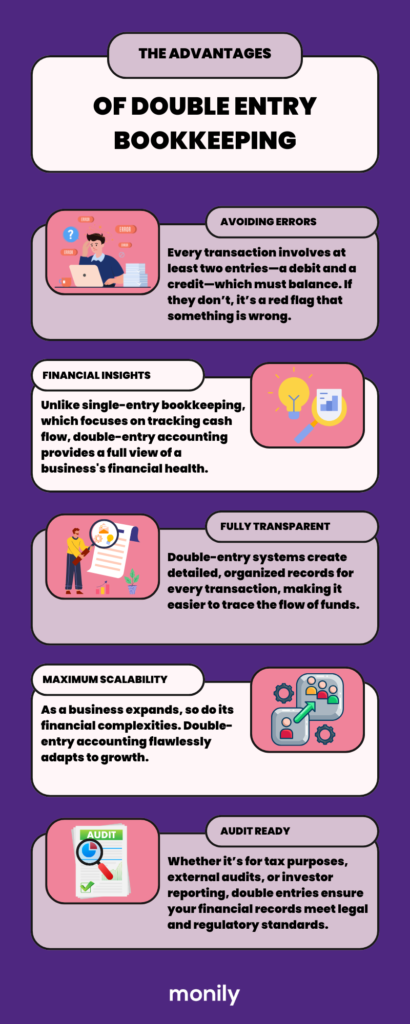
1. Error Detection and Prevention
One of the standout features of double-entry accounting is its built-in error detection. Every transaction involves at least two entries—a debit and a credit—which must balance. If they don’t, it’s a red flag that something is wrong. This system minimizes the risk of undetected mistakes, ensuring that financial records remain accurate and reliable.
2. Financial Insights
Unlike single-entry bookkeeping, which focuses on tracking cash flow, double-entry accounting provides a full view of a business’s financial health. It captures assets, liabilities, equity, revenue, and expenses, allowing business owners to understand their company’s position at a glance. With these insights, decision-making becomes more informed and strategic.
3. Transparency and Accountability
Double-entry systems create detailed, organized records for every transaction, making it easier to trace the flow of funds. This level of transparency builds trust among stakeholders, including investors, auditors, and regulators. When questions arise, the answers are readily available in your books.
4. Scalability for Growing Businesses
As a business expands, so do its financial complexities. Double-entry accounting flawlessly adapts to growth, accommodating intricate transactions, multiple revenue streams, and complex financial obligations without losing its accuracy or reliability.
5. Compliance and Audit Readiness
Whether it’s for tax purposes, external audits, or investor reporting, double-entry systems ensure your financial records meet legal and regulatory standards. They’re essential for preparing compliant financial statements like balance sheets and income statements.
By adopting double-entry accounting, businesses gain not just a bookkeeping tool but a strategic advantage that supports growth, accuracy, and accountability.
Common Challenges in Double-Entry Accounting and How to Overcome Them
While double-entry accounting is a powerful tool for managing finances, it can be intimidating for beginners. Understanding its challenges and how to address them can make the process much smoother. Here are some of the most common hurdles:
1. Understanding Debits and Credits
One of the first stumbling blocks is grasping the concept of debits and credits. These terms don’t align with everyday usage, leading to confusion. For example, a debit increases assets but decreases liabilities, while a credit does the opposite.
The key is practice—think of debits as “increases” in what you own or spend and credits as “increases” in what you owe or earn. Using visual aids like T-accounts can also help clarify these concepts.
2. Balancing the Books
Ensuring that every transaction balances can feel overwhelming at first, especially when dealing with multiple accounts. Beginners might struggle to identify the correct accounts to debit and credit. The solution lies in double-checking entries and using accounting software, which often automates these processes and flags discrepancies.
3. Getting Started Without Expertise
For many, the technical nature of double-entry accounting can be a barrier. Business owners with limited accounting knowledge may feel out of their depth. However, plenty of resources—online tutorials, templates, and beginner-friendly software like QuickBooks or Xero—can simplify the learning curve.
4. Managing Complexity
As your business grows, the number of accounts and transactions increases, making manual tracking harder. Investing in strong and reliable accounting software ensures scalability and reduces manual errors.
5. Misclassification of Accounts
Misplacing entries in the wrong accounts is also often a primary reason that disrupts the accounting equation. Regular account reviews and working with an experienced bookkeeper or accountant can help avoid this.
By understanding these challenges and using the right tools and resources, you can confidently embrace double-entry accounting and unlock its full potential for your business.
Why Modern Businesses Need Double-Entry Accounting
As we go through technological advancements in the 21st century, financial clarity becomes more important than ever. Whether you’re applying for a loan, presenting financials to investors, or simply planning next year’s budget, double-entry accounting is your ticket to making informed decisions.
It’s not just about compliance or tradition—it’s about giving your business the solid financial foundation it needs to thrive.
Wrapping Up: What’s Next for Your Business?
By now, you should have a clear understanding of what is double-entry accounting and why it’s indispensable. But knowledge is only half the battle—putting it into practice is where the magic happens.
Whether you’re just starting your business journey or looking to refine your financial processes, embracing double-entry accounting will set you up for success. So, grab your ledger, choose accounting software, and let the balancing act begin!
Not ready to take it up all on your own? Contact us today and let our experts come in and handle your books for you!

Was this article helpful?
MORE BLOGS
You May Also Like
-
dummy news
It is a long established fact that a reader will be distracted by the readable content of a page when looking at its layout. The…
-
Stripe vs PayPal: Which Payment Platform Should You Choose in 2026?
If you’re a small business, we will absolutely get it if you say you’re having a hard time choosing a payment platform for your company….
-
A Startup’s Guide to Essential Tax Write-Offs and Credits
Starting a business is exciting, right? There’s innovation, there’s growth potential, and the thrill of building something from scratch. But amid all the planning, entrepreneurs…